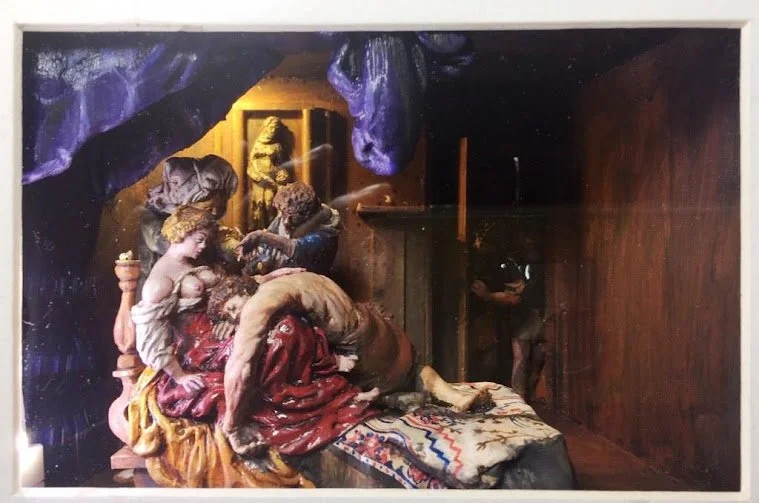
Singaporean modeler Victor writes: “Making figure miniatures has been a life-long passion for me. I’ve dabbled in all aspects of the hobby, from collecting to conversion and sculpting my own unique pieces. I cover all genres, from flats and toy soldiers to model miniatures, displaying them singly, in vignettes and in dioramas. I have also written numerous published articles on various aspects of the hobby. The most visually satisfying displays are the shadowbox dioramas. However, they represent the most demanding genre within the hobby, requiring technical mastery in all aspects of related craftsmanship.
“My first awareness of shadowbox dioramas was marveling at the pieces from Shep Paine and Ray Anderson. Since then, the natural history dioramas of the top museums have provided further inspiration, focusing on the painted background and transiting them into the foreground.
“I started off by using flats to craft my early pieces. These 30mm miniatures allowed for rather grand scenes to be enacted within a small space and with shallow depth. I experimented with various aspects of suggesting perspectives from bas-relief sculpting, placement of key elements to colour painting and composition. https://zinnfiguren-victorwong.blogspot.com/
“When I felt ready, I moved towards using 3-dimensional figures for my shadowboxes. My focus is on translating great art paintings into box dioramas. I selected pieces of increasing complexity to test my understanding of juggling between credible visual perspectives, shadow box depth and size, and fidelity to the painting. Below is an on-going thread where I have collected all my past and present shadowbox dioramas onto a single link. I hope viewers will be entranced by my work and I am honored to be featured on this dedicated shadowbox website.”
https://www.planetfigure.com/threads/my-shadow-box-displays.701741/
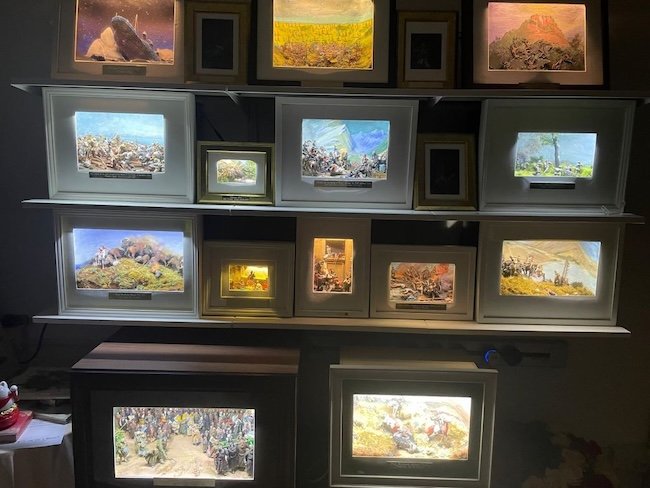
Victor provided the notes for each of the pieces that follow. “These are all retaken pix,” he wrote us in June 2026, “starting off with flats dioramas. I love using flats for staging scenes, and they create perspective depth by simply overlapping the pieces. These shallow dioramas can be wall-hung if not too deep. Due to their small size, 30 mm, large scenes can be realised within a confined space.” Victor’s gallery starts with his photo of his boxes on display.
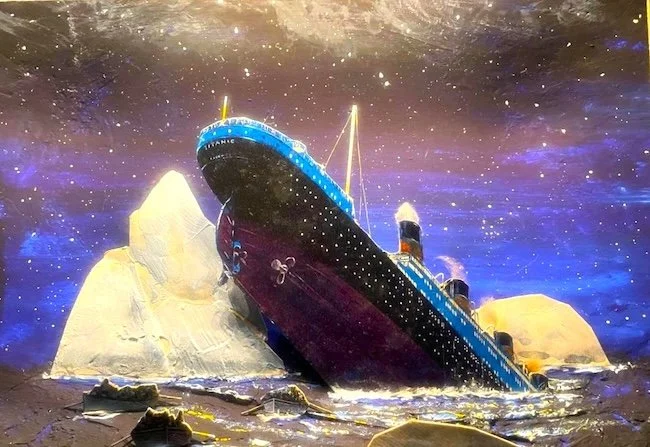
Titanic
The Titanic was a paper cutout culled from the internet. The mast and wires were added, as was the cotton smoke. The icebergs were cardboard painted with silver acrylics.
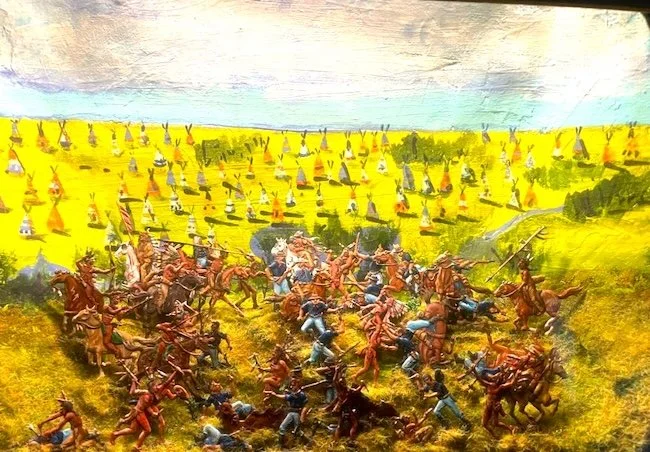
Custer’s Last Stand
Custer’s last stand was a Braune set. I created the ox-bowed river in the background and scattered model grass in the foreground to mask the figure stands.
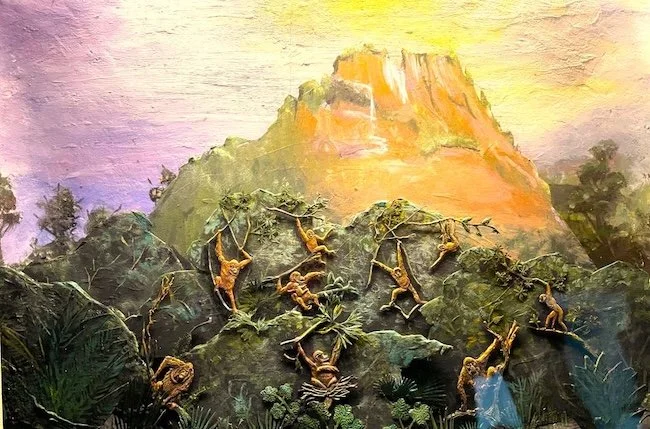
Silver Mountain
The Silver Mountain night scene with apes was taken from a painting by Marianne North, famous for her floral paintings in the Kew Gardens. She had visited James Brooke in Borneo, and I added the apes as they are naturally found in Borneo.
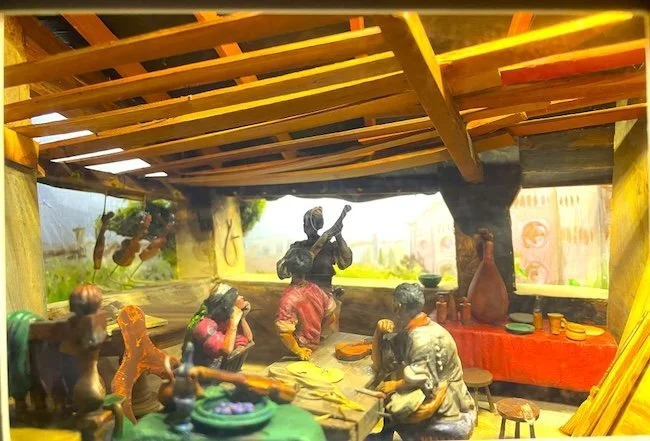
Stradivari’s Workshop
This mid-size shadowbox depicts Antonio Stradivari in his top floor workshop in Cremona. I wanted to capture the dark cool ambience of his veranda as he is giving the finer points of violin-making to his students. Some violins, presumably varnished, are left drying out on the balcony in the sun. The workshop is cluttered with wood and lute pattern templates. The background is fully lit with filtered light allowed into the foreground.
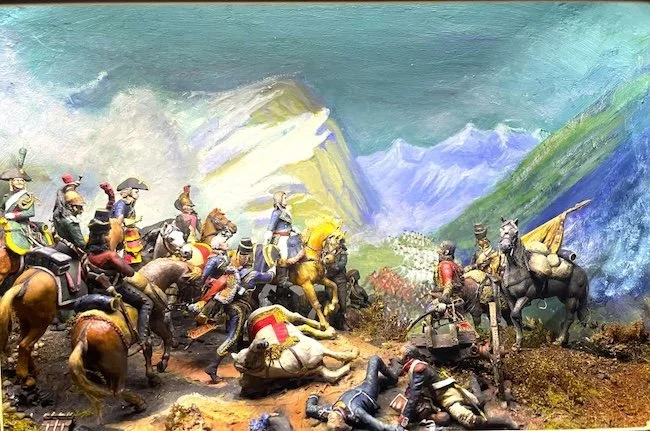
Napoleon at Rivoli
Nap at Rivoli was done to use up my numerous Historex rejected parts, especially the horses, which I had mutilated in my misspent youth. Luckily, I kept the rejects, and they provide a rich parts resource. I did add smaller customised 1/48 figures behind Napoleon and his horse handler to make the transition to the painted background.
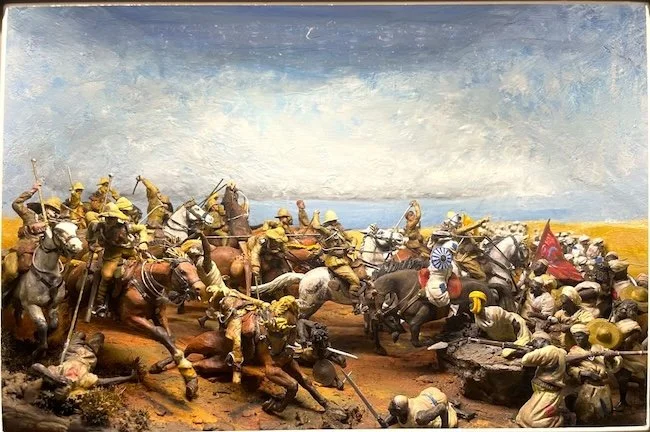
Charge at Omdurman
The Charge at Omdurman was when I felt very conversant with movement, horse anatomy, and forced perspective. I made use of many Airfix 54mm collectible kits and horse parts, as well as Historex and Masterbox parts, and 25 mm Hinchcliffe and 1/72 ESCI figures. I had a blast with this one.
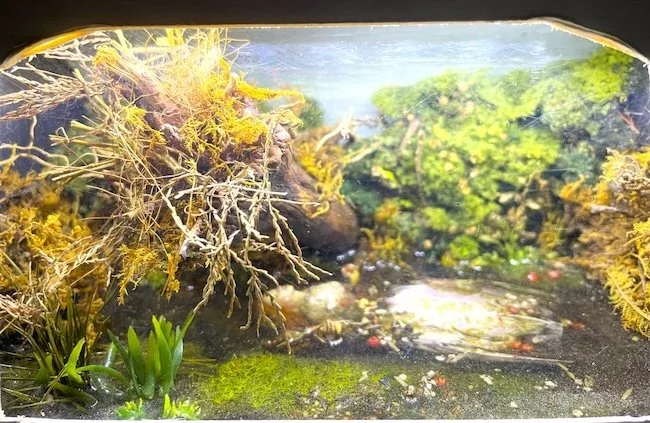
Ophelia
Ophelia is a small shadowbox. I carefully drifted a figure in several layers of resin, whilst arranging her dress and hair to float free and sprinkling embedded flowers in the river.
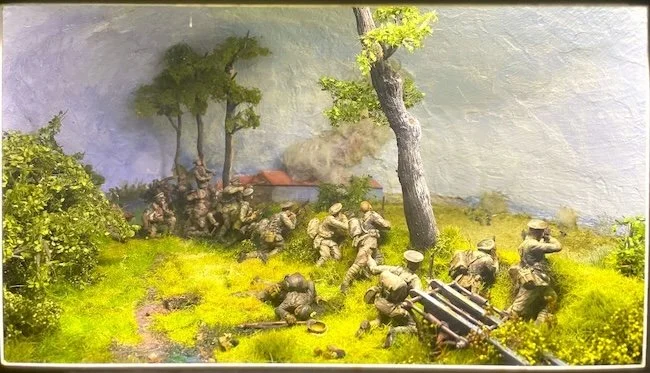
The Contemptibles
This was a chance to use up my Scalelink figures mixed with Airfix and Tamiya and even smaller scales with forced perspectives in a small space.
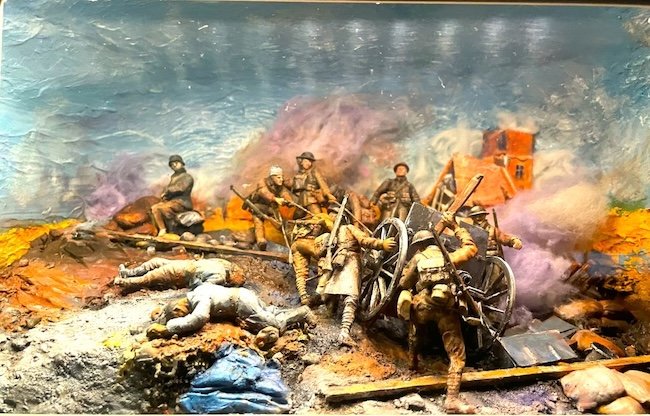
The WWI piece centers on a scratchbuilt artillery gun which I had knocked up from bits and pieces. I changed the whole scene from a cold to a warm hue before I was satisfied.
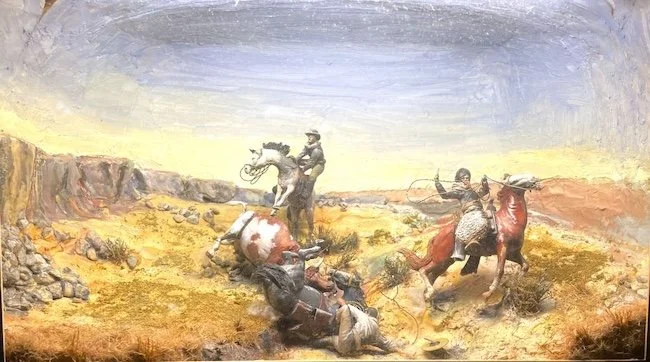
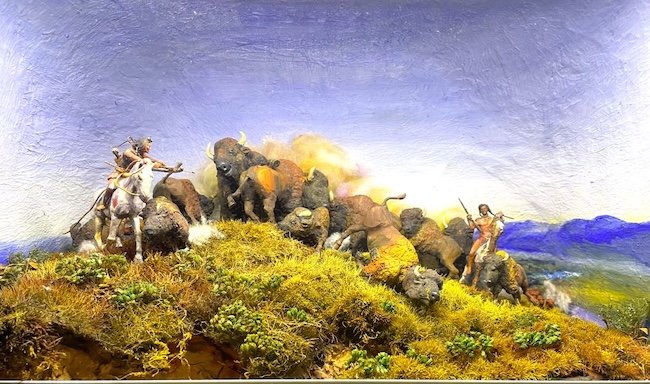
These two pieces were inspired by the paintings of Charles Russell. I really wanted to explore depicting wide open spaces within the confines of a box, and selected the wild west genre. The cowboys and Indians were all made from discarded parts. The bison were made from my own sculpted bison heads and cast in resin. I made three sizes to give variations. Bodies were a mix of wire armatures and Airfix and Historex horse limbs. The terrain in both pieces are the lynchpin features.
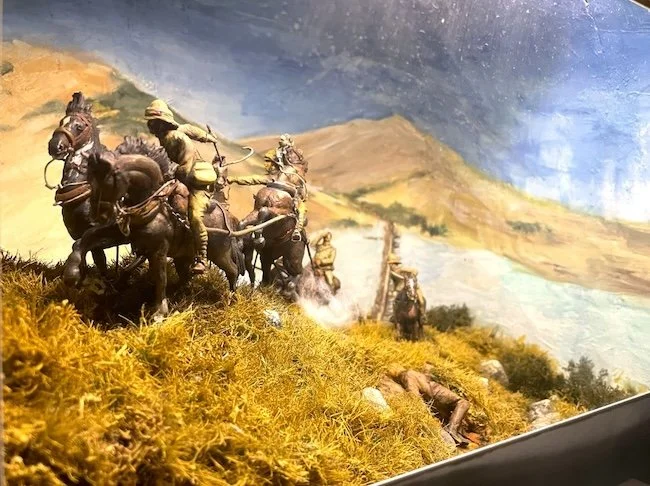
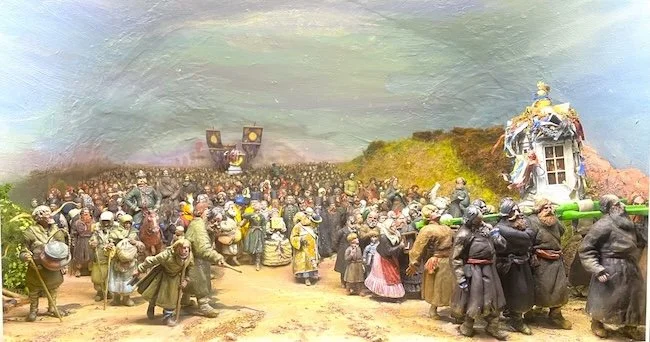
These two pieces were further explorations in open terrain and complexity. The artillery team was challenging to build and involved careful use of visual perspectives. The procession consists of numerous figures with facial features which were modeled as in the painting, all sculpted or converted from my considerable collection of all scales of figures. The back row figures were made from resin castings made from my own sculpted figures to speed up the work. The furthest figures were suggested with pins.
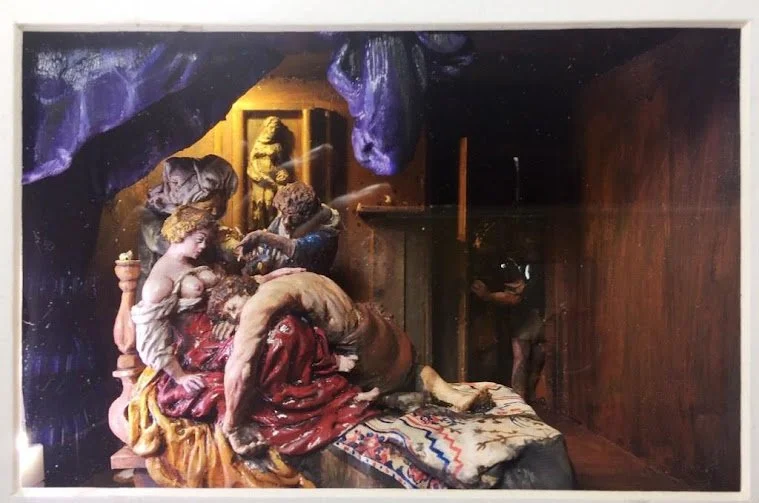
“Samson and Delilah”
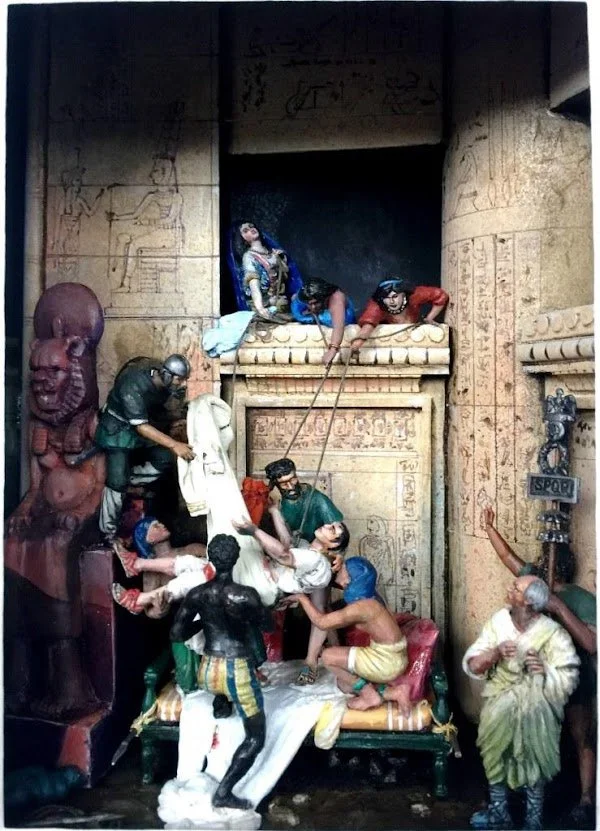
Antony and Cleopatra
Antony and Cleopatra was one of my earlier forays into shadowbox pieces. Not much visual perspective, but I learned how to create cardboard buildings. I loved the composition of this piece; it had a dramatic, poetic setting.